We Need Creators, Not Clerks
A call to unshackle India’s classrooms from colonial conditioning and reimagine education that inspires innovation, not imitation.
Soumia Grace Lobo
10/28/20252 min read
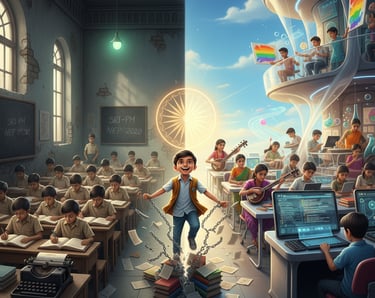
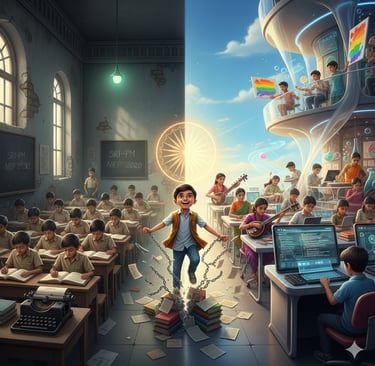
For decades, India has prided itself on being the land of ideas — yet our classrooms have quietly killed imagination. We inherited an education system designed not to liberate minds but to discipline them; not to awaken curiosity but to produce compliance. The colonial classroom still lives among us — neat rows, silent students, fearful teachers, and a syllabus that rewards repetition, not reason.
It was a system built for another century, another purpose: to serve an empire, not a democracy.
To create clerks, not creators.
And every time a bright Indian child learns to memorise without questioning, we continue to serve that empire’s ghost.
The PM SHRI (Pradhan Mantri Schools for Rising India) initiative, aligned with the National Education Policy 2020, promises to change that — to bring learning out of textbooks and into life itself. It envisions classrooms where knowledge is not dictated but discovered, where children learn through art, science, language, technology, and empathy. It seeks to bridge the gap between privilege and potential — making world-class education accessible in every corner of India.
But let’s be clear: no reform, however visionary, can succeed if it becomes a political trophy. Education cannot be reduced to a contest between Centre and States, or between ideologies. It is not a party agenda — it is a national responsibility.
When states like Kerala, the torchbearer of literacy and inclusive education, raise concerns, we must listen, not label. Their resistance isn’t defiance — it’s a reminder that education must be built with consensus, not coercion. If the PM SHRI initiative becomes a centralised command rather than a collaborative movement, we will lose the very soul of what it aims to protect — diversity, autonomy, and creative freedom.
Education is not a policy to be implemented; it is a promise to our children.
A promise that we will prepare them for the world that awaits — a world of machines that can think, economies that demand innovation, and societies that need compassion. We cannot send our children into that world armed only with outdated syllabi and memorised paragraphs.
The greatest injustice we can do to the next generation is to educate them for a world that no longer exists.
This is not a battle between the Left and the Right, between the Centre and the States. This is a battle for the soul of India’s future — for the kind of citizens we hope to raise. If we want a nation of problem-solvers, innovators, and leaders, then our classrooms must first become places where curiosity is not punished, where failure is not feared, and where questions are not silenced.
The PM SHRI schools can be that revolution — but only if they are born out of dialogue, not decree. The Centre must provide the framework; the States must shape it. Teachers must be trusted as the architects of change, not treated as executors of orders. Parents must see education not as a race, but as a journey of discovery.
It is time we move beyond the shadows of colonial education and design a system rooted in India’s greatest strength — its diversity, its resilience, its ability to dream. Our goal must be not to fill children with information but to ignite imagination.
We owe our children a future where they don’t just survive — they thrive.
Where they aren’t afraid to think differently, to challenge, to create.
Where they inherit not our fears, but our faith — that learning can, and must, change the world.
Because the measure of a nation’s progress is not in the number of its schools, but in the freedom of its students to imagine a better tomorrow.
And that tomorrow begins the day we stop producing clerks — and start raising creators.
©2026 NuzRapCo.™ All Rights Reserved. Trademarks under Classes 16, 35, and 41 are protected