Sketch to Screen
How Technology Is Redesigning Fashion Without Wasting the Future
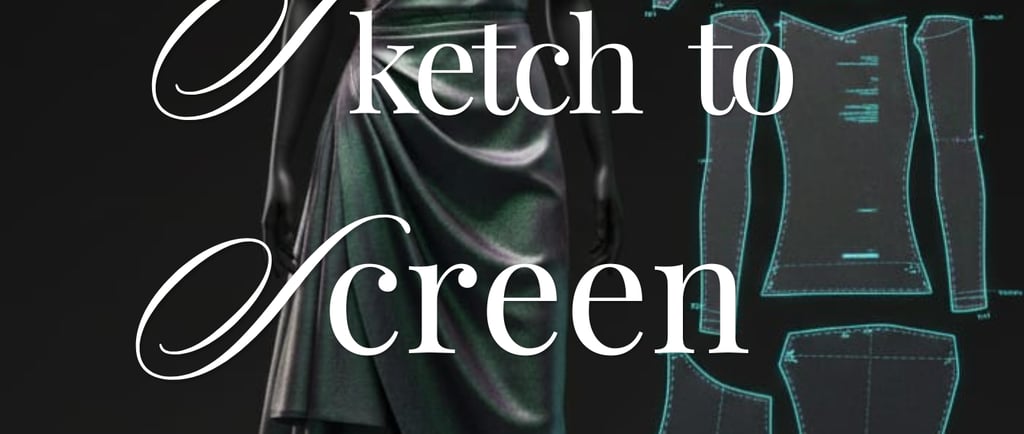
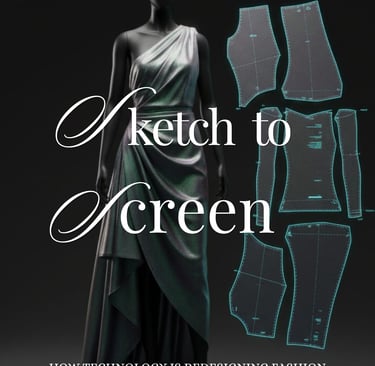
Fashion has always begun with a sketch — a line drawn by hand; an idea translated into form. For centuries, that first stroke moved quickly into fabric, samples, production, and often, excess. Today, fashion’s journey is being rewritten. The shift from sketch to screen is not simply digital; it is intentional, intelligent, and necessary. As the industry confronts its environmental and social footprint, technology has emerged not as an accessory, but as infrastructure.
Under Sustainable Development Goal 9 — Industry, Innovation and Infrastructure — fashion is learning to innovate responsibly. The focus is no longer on producing more, faster, but on designing better, smarter, and with accountability built in. The sketch remains sacred. Creativity still begins with the human mind — shaped by culture, emotion, memory, and lived experience. What has changed is what happens after the sketch is made.
Traditionally, turning drawings into garments involved multiple physical samples, repeated alterations, and material waste long before a product reached the consumer. Fabric was cut prematurely, water was consumed excessively, and labour was stretched to meet speed-driven timelines.
Artificial Intelligence introduces a pause — a moment of foresight. AI design tools analyse data ranging from consumer behaviour and regional preferences to climate impact and material efficiency. Designers can test ideas virtually, forecast demand more accurately, and reduce unnecessary variations. Instead of guessing trends, brands respond to insight. Creativity is not replaced; it is supported by informed decision-making.
This shift dramatically reduces overproduction. Fewer unsold garments mean less waste, fewer markdowns, and more respect for resources. AI transforms fashion from an industry of assumption into one of intention.
One of the most visible changes from sketch to screen is the rise of 3D sampling. Physical samples, once essential, are now optional. Through advanced digital simulation, garments are created on screen and tested on virtual bodies. Designers can examine fit, drape, texture, and movement in real time. Alterations happen instantly, without cutting fabric or shipping prototypes across borders.
The environmental impact is significant. Water usage drops, textile waste is minimised, and carbon emissions linked to logistics are reduced. Time is saved, costs are lowered, and precision improves. Sustainability, here, is not a compromise — it is a refinement.
SDG 9 reminds us that innovation must be supported by resilient systems. In fashion, this means building digital infrastructure that connects designers, manufacturers, and suppliers transparently. Technology-enabled platforms improve communication, traceability, and accountability across the supply chain. When everyone works from the same digital blueprint, inefficiencies shrink and ethical practices become easier to enforce.
Perhaps the most radical expression of fashion technology is digital fashion — garments that never physically exist. Designed to be worn in virtual spaces, social media, gaming environments, and immersive platforms, digital fashion offers expression without extraction. No fabric, no water, no waste.
In a world where identity increasingly lives online, digital fashion challenges the idea that value must be tangible. Luxury shifts from ownership to originality, from material accumulation to creative storytelling. It invites fashion to rethink desire itself.
Technology, however, is not the enemy of craftsmanship. In many ways, it is its protector. By reducing waste and overproduction, designers and artisans can focus on quality, longevity, and meaning. Small batches, bespoke work, and culturally rooted design become viable when supported by intelligent systems. Innovation allows fashion to slow down without losing relevance.
From sketch to screen, fashion is building a new blueprint — one where creativity is guided by insight, production is guided by responsibility, and expression is freed from excess. The future of fashion will not be defined by how much it produces, but by how thoughtfully it designs.
This is not fashion surrendering to technology. It is fashion finally learning to design with intention, integrity, and infrastructure that respects both people and planet.
For digital readers, this journey unfolds seamlessly. The scroll replaces the runway, guiding the eye from hand-drawn lines to data-driven design, from virtual prototypes to intangible garments. Each stage becomes a chapter, not rushed but revealed. Digital-first storytelling mirrors digital-first fashion: layered, interactive, and conscious of pace.
As consumers scroll, they witness process, not just product. Transparency becomes design language. Technology invites audiences behind the scenes, encouraging awareness and informed choice.
Fashion is no longer a finished object presented at the end; it is a visible evolution.From sketch to screen, the message is clear. Sustainability is not an afterthought stitched onto style. It is embedded at the very start, written into systems, tools, and decisions. Innovation, when guided by responsibility, does not dilute fashion’s soul. It sharpens it.
The future is already being designed — line by line, pixel by pixel — with intention.
©2026 NuzRapCo.™ All Rights Reserved. Trademarks under Classes 16, 35, and 41 are protected