Sajan John : Champion of Marine Conservation
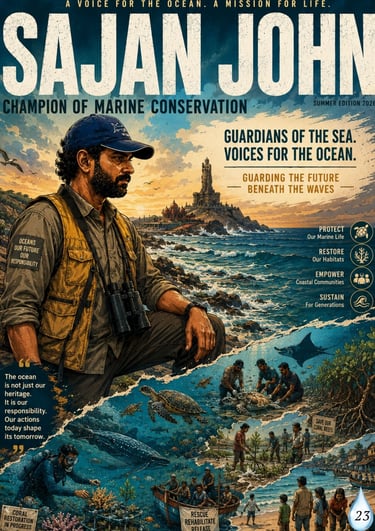
In a world searching for heroes, some quietly dedicate their lives to protecting what cannot speak for itself. Through decades of work in marine conservation, whale shark protection, habitat restoration, and community engagement, Sajan John has become a powerful force for ocean stewardship in India.
Slobo
Conservation today often depends on visibility and attraction. Do ecosystems need to be ‘seen’ and valued aesthetically before they are protected—or can conservation exist without that human validation?
Human psychology is to admire what is visible. Marine conservation came to the mainstream very late. This is because 90% of marine life is underwater beyond the visible spectrum of a normal human being. But terrestrial conservation went far and long. India initiated Project tiger during 1973, and Project elephant during 1992. However, the largest fish on planet earth –Whale shark got a place in the Indian Wildlife (Protection) Act only in 2001! More visibility will give the species and habitat more chance to survive.
Which coastal or marine ecosystems in India do you believe are critically important yet remain under-recognized or overlooked?
This is true in every sense and not only applicable for marine conservation. Species that are smaller and habitats that are not really understood will not get enough conservation attention. For example, Amphibian conservation.
We all know that frogs are very important, however being small and elusive the conservation attention that is given to frogs and its critical habitats are very less. Similarly, coastal and marine habitats that get conservation attentions are mangroves, coral reefs and seagrass ecosystem. Conservation of habitats like coastal sand dunes and oyster beds are seldom talked about.
How aware are local communities of the long-term impact of their daily interactions with these ecosystems—and where do you see the biggest gap between awareness and action?
There is always a disconnect between conservation and communities. The major reason for this was, we never valued the community’s real contribution. Most of the policy decisions were top down. This kept the communities away or in other words the policy makers deliberately pushed the communities out from the complex conservation equation. If we want a behavioural change, we want them from day one. Communities should be made the owner and in charge of the conservation program then only we can see the results.
From your experience, what are the most persistent challenges governments and conservation bodies face in regulating harmful activities along coasts and marine zones?
The laws are made very effectively to conserve and protect the coastal habitats. However, in the name of coastal development many laws are diluted. Since coastal areas are very important for the country’s economic growth, the government many times allows development along the coastal areas without a clear understanding of the entire coastal dynamics.
Tourism brings visibility and economic value, but also pressure. Where should we draw the line between promoting natural spaces and protecting them from overuse?
Tourism (to be specific eco- tourism) is considered as an alternative source of income for coastal dependents. This was projected as a mechanism that can reduce the dependency of coastal communities on extracting the coastal and marine resources (like fishes, sea weeds etc). However, in many places the real meaning of eco-tourism was never understood clearly. Both the decision makers and the tourists who are coming to these areas are equally responsible for this. Tourists need good facilities and to create that facility habitats like mangroves or corals are damaged. In the name of constructing jetties for docking the boat coral habitats are damaged and in the name of boardwalks mangroves are cut. The real meaning of eco-tourism is to admire the beauty of nature. The tourists who are coming should be made aware of these critical habitats, then they will admire the ecosystem and the species within.
As luxury increasingly positions itself around nature—beaches, lagoons, coastal retreats—how can this relationship evolve from being extractive to genuinely responsible?
Conservation is not an option, it is a necessity now. Many businesses use conservation to place themselves higher on a market, they have a strategy. The businesses who invest more on these conservation of critical habitats offset more carbon than they produce. This will reduce the net carbon footprint of that industry making it greener and appealing for the public. Because of this, many polluting industries are now into habitat restoration and conservation so as to reduce their carbon footprint. I think this is a good move, because this will at least make the industries think to reduce the carbon emission and also support other habitat recovery efforts happening in other parts of the country.
We often speak about preservation, but what does genuine, long-term conservation truly require from individuals, institutions, and industries today?
The damage we have caused can’t be reversed in a decade. The habitat or species recovery is very laborious and it requires time. We just don’t want to restore a habitat; the restored habitat should be a functional habitat. It should perform all duties of a natural habitat. So, this will take time and requires long term commitments. Even Though government and other conservation agencies are into habitat restoration, I think it is not only their duty. Communities and corporations should join hands to provide sustained support for habitat recovery.
Abandoned fishing nets, often referred to as “ghost nets,” continue to trap and kill marine life long after they are discarded. How significant is this threat in Indian waters today, and what makes it so difficult to address?
Ghost net is becoming a serious threat to the marine ecosystem and since oceans are connected many times the abandoned nets from other countries also enter the territorial waters of India. These abandoned nets not only trap endangered animals but also leach harmful chemicals as the nets slowly disintegrate in sea water.
Many times fishers lose these nets due to rough seas. There are also chances for fishers to cut the net and abandon it when these nets get entangled in underwater rocks/shipwrecks etc. These abandoned nets will either float or sink depending on the nature of the nets trapping and killing many marine lives.
The effective way to remove the Ghost net is to retrieve them and bring them on shore. However, it is largely possible only if these nets are floating. Fishers can collect it during the fishing operations and bring it. If the nets are trapped underwater (entangled on rocks) it will be practically difficult to extract it. Many divers during their dive operations also collect these nets. However only small quantities can be retrieved by divers. Sensitising fishers is the foremost thing to do. Not only fishing gears, any sort of solid waste disposal into the ocean needs to be stopped.
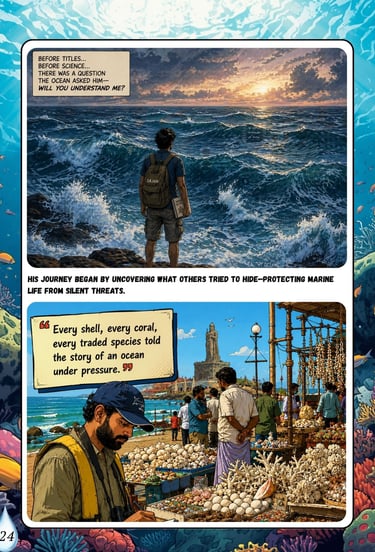
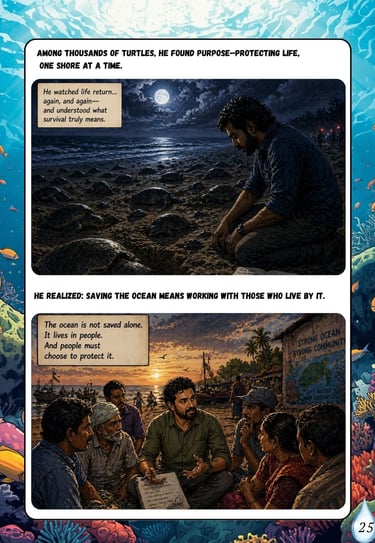
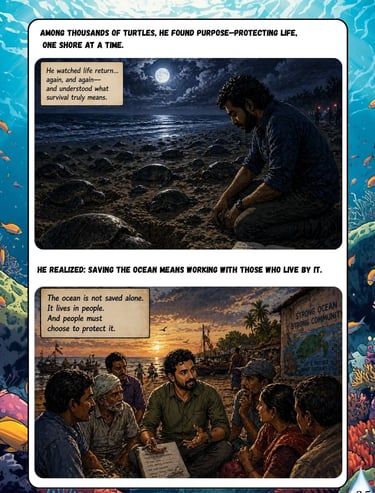
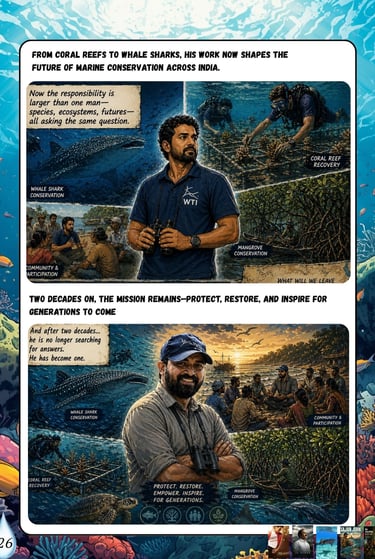
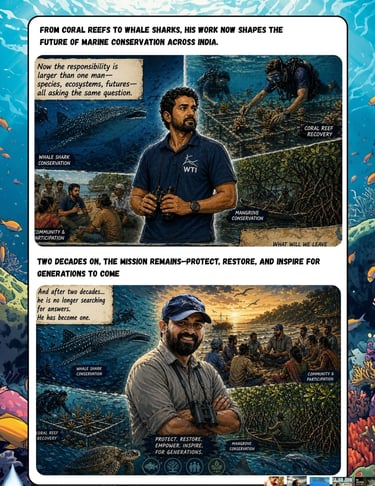
In a world where oceans are too often admired only from the shore, marine conservationist Sajan John has spent decades looking deeper—into ecosystems, species, and coastal realities most people never truly see.
From documenting the open trade of protected marine life during his early years with the Wildlife Institute of India, to leading marine conservation projects across Gujarat, Kerala, Lakshadweep, and Goa with the Wildlife Trust of India, his journey has been shaped by one enduring belief: conservation begins by understanding what humanity has learned to overlook.
Over the years, his work has extended beyond research into something larger—restoration, community participation, habitat recovery, and long-term protection of fragile marine ecosystems. Whether through whale shark conservation, coral reef recovery, mangrove restoration, or addressing invisible threats like ghost nets, Sajan John’s work reflects the growing urgency of protecting life beneath the waves before it disappears in plain sight.
In this exclusive conversation with Soumia Lobo for NuzRapCo’s A Tribute to the Oceans edition, he speaks about visibility in conservation, overlooked ecosystems, tourism pressures, coastal development, community participation, and the difficult balance between human ambition and ecological survival.
This is not simply an interview about marine conservation.
It is a conversation about responsibility, survival, and the future of the oceans themselves.
©2026 NuzRapCo.™ All Rights Reserved. Trademarks under Classes 16, 35, and 41 are protected